

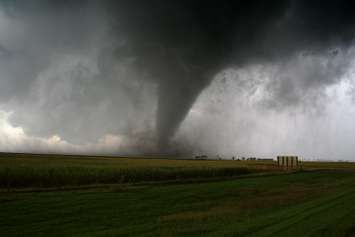
Last year was another record year for tornadoes in Canada.
The Northern Tornadoes Project (NTP) at Western University recorded 117 tornadoes across Canada during the 2022 season, tying with 2021 for the highest number on record for a single season.
NTP has been detecting, surveying, and documenting tornadoes for only four years, however, the totals for 2021 and 2022 saw a significant jump from previous seasons. According to the researchers, there were 103 confirmed tornadoes in 2020, and 72 in 2019.
As for the severity of these twisters, 29 tornadoes reached EF2 on the Enhanced Fujita Scale. An EF2 tornado is the third weakest on the scale, but can still be quite dangerous with wind gusts from 180-220 kilometres per hour.
On top of the tornadoes, NTP reports a total of 94 downbursts in 2022, some of which also reached EF2 intensity.
The most significant severe weather event of the year happened in spring 2022. On May 21, a derecho hit the country’s most densely populated areas throughout Ontario and Québec, leaving 12 people dead, 12 others injured, and more than $1 billion in damages.
NTP’s Executive Director David Sills says his team continues to research this catastrophe.
“The May 21 derecho was an extreme thunderstorm event that we will be studying for some time,” said Sills.
Founded in 2017, NTP’s goal is to better detect tornado occurrences across the country, improve weather prediction methods, investigate climate change, and reduce collateral damage from these natural disasters - whether it be property or people.
Western University touts that NTP confirmed 80 of Canada’s 117 tornadoes in 2022.
“We’re getting closer to the 150 or so tornadoes that we projected for our national annual average based on statistical analysis, so it appears the number of ‘missing tornadoes’ in Canada is gradually dropping due to the continually improving efforts of NTP,” said Sills.
The research team conducted 447 severe weather investigations last season, including 392 high-resolution satellite imagery surveys, 12 aircraft surveys, 30 drone surveys, and 34 ground surveys.
NTP’s full annual report for 2022 is now published online.
“While the COVID-19 pandemic still required caution in the field during the 2022 season, it was not nearly the challenge it had been in 2020 and 2021,” said Sills. “The bigger challenge was ramping up the pilot season for the new Northern Hail Project (NHP) while keeping NTP running smoothly. We’re happy to report that both projects had very successful seasons in 2022.”
NHP is a similar initiative at Western University that will zero-in on hail storms across Canada.