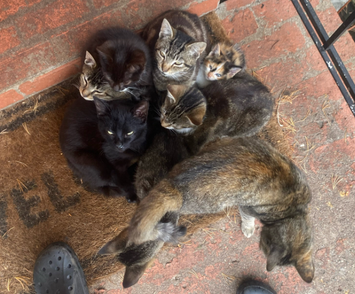
A family is calling out a Thamesville cat rescue for allegedly refusing to return six barn cats that were brought to them.
On Saturday, Dean Patterson realized several of his cats were missing, prompting his wife to post on Facebook asking if anyone had seen them. He claims that a man who visited their farm when they weren't home saw the cats being picked up by a woman in a Toyota Corolla, providing a photo as proof.
This led them to believe that the cats were stolen, which prompted a second Facebook post asking for help. Patterson explained that his wife received a message from Wandering Whiskers Cat Rescue, which said a woman found the cats on a road and dropped them off.
The family alleges they asked for the cats back, but were told no. Patterson claims the rescue's owner accused them of neglecting the animals.
"She's claiming they have three different internal parasites, but the only way to [check] is to take a fecal sample and test it. She's claiming she can look at a cat and know it has issues," he explained.
Patterson wasn't surprised to hear that the cats may have a parasite, since it's a common ailment for outdoor pets. This was backed by Myriam Armstrong, the executive director of the Pet and Wildlife Rescue (PAWR), who told CK News Today that more often than not, farm cats brought to them have parasites from eating rodents.
What confused Patterson is the rescue using the parasites as an excuse to say they were being neglected. He added that if the rescue just recommended he have the cats looked at, he'd do so.
"If a vet said they truly need something, I'd be willing to listen to the vet and see what they recommend," said Patterson.
No matter what the cat's health truly is, Armstrong said rescues cannot legally withhold sick animals from owners. She added that they can have animal welfare check up on the animals, but they simply can't keep them away from their owners.
The family has contacted Chatham-Kent (CK) police, which they say has offered little help. Patterson said they were told by an officer that all they could do was ask the rescue to return them, but couldn't force them to.
This confused the family, as pets are considered property in Ontario, which to them meant police should have helped return them. This also perplexed Armstrong, who's spoken with police on behalf of the family. To her, she believes this should be a simple case for police.
CK News Today reached out to CK police, but has yet to receive a response.
The family is also concerned the rescue will try to claim that they don't own the cats. This is because none are tagged and aren't routinely brought to vets, which could have provided a medical history as proof of ownership.
Patterson said they have photos of the cats, some with members of the family, which to them proves that the cats belong to them.
Jim Brackett, the president of the Kent Federation of Agriculture (KFA), believes it'd be a slippery slope for any rescue to try and claim farmers don't own their outdoor cats.
"Farm cats have never, to my knowledge, been microchipped or documented. They are very valuable for mice and rat control, especially for farms with animals."
Meanwhile, Patterson is thankful for the support his family has received, but is shocked that they're even in this situation.
"We just thought somebody randomly stopped and picked them up. Never did I imagine that it would be a supposed cat rescue," he added.
Along with getting their cats back, the family is hoping that by sharing their story, others don't have to go through the same experience.
Wandering Whiskers response
CK News Today reached out to Wandering Whiskers for comment on the allegations. The rescue was sent a list of questions and provided the following answers, which are printed in full:
1. Does the rescue, in fact, have these six cats?
"Wandering Whiskers Cat Rescue can confirm that we currently have six cats in our care. These animals, to our knowledge, were not taken from private property. They were safely recovered by a compassionate member of the public while they were roaming directly on and alongside a public roadway, where they posed an immediate traffic hazard and were exposed to weather and predators."
2. If the rescue has the cats, why is the rescue not returning them?
"As a registered animal welfare organization, Wandering Whiskers is legally and ethically bound by Ontario’s Provincial Animal Welfare Services (PAWS) Act to ensure animals are not knowingly returned to a situation of distress or medical neglect. Furthermore, under standard shelter protocols, because these cats lack microchips, municipal tags, or distinct registered identifiers, we are legally required to perform due diligence to verify true ownership before any animal can be discharged. During conversations with the individuals claiming to be the owners, we provided photos of cats in an email, 4 which were from the batch that recently came in, and 2 that were not. The owners claimed all 6 were theirs. This seems to indicate the potential owners may not be fully aware of exactly how many cats they had, nor the exact ones that are missing."
3. The family says they have photos to prove that the cats belong to them; is this not enough proof that they should be returned?
"While we understand the family's frustration, a general photograph of multiple free-roaming cats eating together does not constitute definitive proof of legal ownership or identity for six specific, un-microchipped animals. Because free-roaming barn cats frequently move between multiple neighboring properties for food and shelter, a photo alone does not establish exclusive legal title or medical responsibility under Ontario property law. This would be equivalent to us taking a photo of your bicycle and saying it is ours because you let us ride it one time. Proof of ownership that we would find acceptable under Ontario property law that is conclusive, would include vet bills, microchipping, any formal records and documentation from a vet. Otherwise, unfortunately because Chatham-Kent allows cats to roam free, without some form of policy or system in place, we simply follow the laws that are in place. The current Chatham-Kent By-law states: Our (Municipality) contract with PAWR includes many services including picking up stray dogs, dog bites, prohibited animals etc. but does not include picking up stray cats. PAWR is contracted to provide free intake for stray cats brought into the Chatham-Kent Animal Shelter located at 405 Park Ave E, Chatham." We have been informed that unfortunately at this time PAWR has a waitlist for strays because they are so full."
4. The family claims that the rescue told them that the cats were in horrible condition. How did the rescue determine this? Did the rescue go to a veterinarian? Besides parasites, what other illnesses do the cats supposedly have?
"Despite the fact that these questions feel opinionated and accusatory, we would like to still share that upon intake, our experienced rescue team identified acute physical distress that extends far beyond the claimed routine outdoor parasites. The rescue has supported over a thousand cats in the CK area thus far with the weekly support of veterinarians. The cats presented with upper respiratory infections, lice, ear mites, three different types of worms, fleas and one cat aged approximately 3 years has only 3 teeth left that are rotting out leading to an infected mouth. The cats were given medical support and are undergoing necessary, ongoing as needed, veterinary-supervised treatment. They are currently not medically stable enough to be moved or discharged. Legally, we cannot release animals whose acute medical needs are actively unmet. On another note, we are unsure regarding the comment that parasites are common? Is this to downplay their seriousness or to say they aren't harmful? Because if left untreated it can cause severe health risks or death. Heartworm, for example, is merely one of the deadly parasites for both cats and dogs that cannot be left untreated."
5. The family also believes the rescue is rounding up farm cats to be adopted, since the rescue requires a $200 fee for each adoption. Is there any truth to this claim?
"There is absolutely no truth to this claim. It is a curious line of questioning as all charities do not make a profit and all cats to our knowledge have an adoption fee from rescues or shelters to cover costs of care. The Ontario SPCA website posts their adoption fees at $260 for reference. Wandering Whiskers does not 'round up' animals. We respond strictly to stray, abandoned, or injured animals brought to us by the public or through agreed upon Trap Neuter and Rehome/Release plans with home owners at our own time and cost. The $200 adoption fee does not generate a profit. In fact, it covers only a small fraction of the actual costs of care, which include mandatory spay/neuter surgeries, microchipping, age-appropriate vaccines, deworming, and emergency veterinary bills. For these six specific cats, the cost of their current emergency medical treatment already far exceeds any standard adoption fee. Our sole goal is the recovery and welfare of the animals. We also have not finalized any costs with any parties as of yet."
In closing, Wandering Whisker said it is open to returning the cats, if certain criteria are met.
"Wandering Whiskers is actively trying to work out a cooperative, conditional release plan with the individuals claiming ownership. Our conditions are standard for any responsible rescue: we require a verified commitment to the continuation of the cats' medical treatments, mandatory microchipping so their identity is never in question again, and reimbursement for the emergency veterinary bills incurred to stabilize them," it said. "Our priority is not to keep these cats, but to ensure that wherever they go, they are legally protected, healthy, and safe. We no doubt believe that people love their pets, however on a broad scale it is irresponsible to allow a colony to exist unaltered and continue to inbreed and spread sick cats across the municipality. No other animal is allowed to do so."