
The Upper Thames River Conservation Authority (UTRCA) has been able to implement additional measures to remove invasive plants locally through a recent surge of funding.
The organization, which covers areas along the upper watershed of the Thames River, received $10,000 in funding from the Invasive Species Centre to clear out invasive plants including Dog-Strangling Vine, Japanese Knotweed, and Giant Hogweed.
These plants grow throughout the watershed, but are a threat to local biodiversity and a hazard to the community.
“The cost to manage these three invasive species is staggering,” said Land Management Coordinator Brandon Williamson. “The longer we wait to implement control measures, the greater the impact will be economically and on the environment. That is why the Invasive Species Action Fund has been so important.”
The UTRCA said Dog Strangling Vine is an aggressive plant that out-competes native vegetation, making the area around where it grows unsuitable for other species. Japanese Knotweed, is often found along roadsides. It can break through concrete and foundations, creating visual barriers along the road where it grows. Giant Hogweed is highly toxic to humans who come across it in flood plains and near riverside trails.
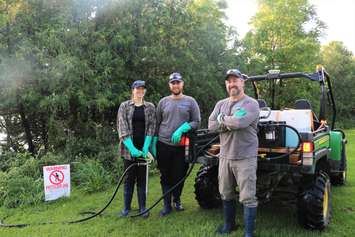
Control measures to remove these species includes removing seeds by hand and applying herbicide directly onto the leaves and into the stems of the plants. Workers also use drone technology to map out inventory of some species in difficult to reach areas along the Thames River.
“It is important to keep up our efforts to manage these species to maintain biodiversity, protect people from injury, and prevent infrastructure damage and reduced property values,” Williamson said. “We encourage community members to inform UTRCA staff of the locations of these invasive species as we build the data set of their distribution across the watershed.”