
We've had a lot of talk recently, about tillage. Or lack of it.
But I was reminded this week of another factor. One over which we have very little control.
[audio wav="http://blackburnnews.com/wp-content/uploads/2015/08/COMMENT-THURS-AUG13.wav"][/audio]
Strip till, no till, and those who say, rightly or not, that all of the new devices designed to keep nutrients in the soil and not in the water, and designed to let the worms do the work for you, are fine but every so often you are still going to have to plow.
I don't know if that is right or wrong, it is not for me to say.
It is encouraging to hear of more interest in conservation tillage however it has been a long time coming, and there still needs to be more.
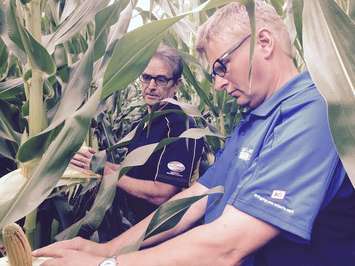
I had a chance recently to walk with some very knowledgeable people through a corn field and then a soybean field, and what I learned is that no matter how good the farmer is, no matter how careful the preparation and how good the science: nature trumps everything.
Of course the difference between parts of Essex County and Chatham-Kent underscore that in the extreme.
In Essex thousands of acres didn't get planted, and still more don't look good because of extreme wet condition in the spring, while in Chatham-Kent for the most part things are looking pretty good.
But even in areas where things are looking pretty good, mother nature rules all.
A corn field that has the potential to yield 300 bushels to the acre is going to need five inches of water, I am told, to finish properly.
Much of that is in the ground now for that field so nature has cooperated.
Another example, this is August. There is the potential for a few more pods to set on the top of soybean plants. But with nightly lows in the low teens that may not happen.
I am told that if warm weather returns it could add ten bushels to a crop of beans.
So even in areas where everything has been done properly, where cover crops and rotation and tillage are what they should be, the old saying that "it's not a crop until it's in the bin," is very true.
And with the ups and downs of the markets, and the slippage and sometimes strength of the Canadian dollar, the next part of that old saying, "it's not money until it's in the bank" is also underscored.
No doubt providing lots of topic for conversation at the August farm tours and meetings.