

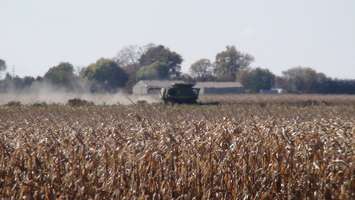
If you're still about to head out and combine soybeans, or if you're going to be harvesting soys next year, Real Agriculture agronomist Peter Johnson wants you to consider the spread coming out of your combine.
He says fields with uneven residue areas can lead to varying planting depths and drills move across them, leading to non-uniform stands.
Johnson adds the lack of uniformity can lead to uneven emergence, which hampers trying to time out future applications like putting Fusarium fungicides on wheat.
Today's combines are also getting wider and wider to maximize field effeciency.
The agronomist feels farmers should try to change up their combine paths each fall.
Starting on the same side year after year and following GPS, fields are now starting to show noticable potash defiencies in the areas with less residual spread in as little as five years.
Johnson points out as well that the returned potash residue is more readily available as it cycles faster in its organic form.
So even if there's potash in the soil, uneven plant growth can still occur across the field as the residual potash is absorbed into to the crop faster than than the potash originally left in the soil.