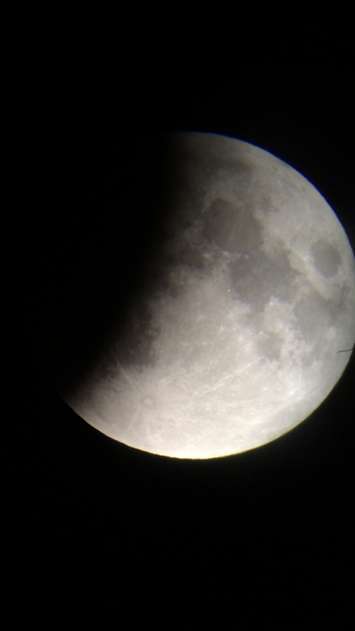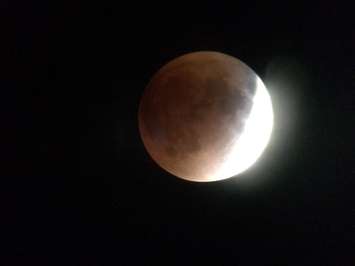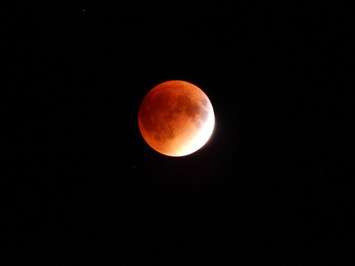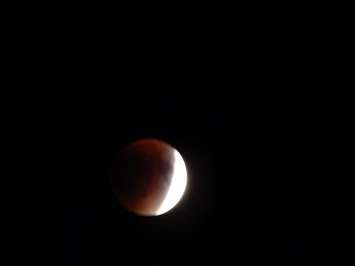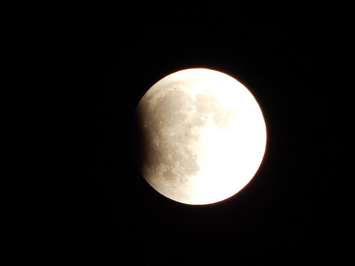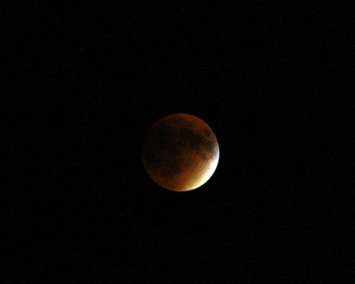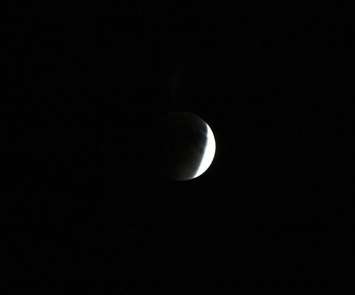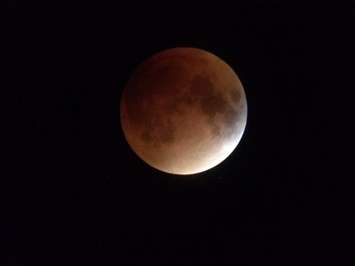

Star gazers were given a rare opportunity to witness an event that hasn't been seen in decades.
Last night, a total lunar eclipse combined with a super moon was visible in the night sky. The event is known to astronomers as a "super blood moon" and hasn't occurred since 1982.
Dennis Crabtree, director of optical astronomy for NRC Herzberg, says during the midpoint of the eclipse, the moon will take on a deep redish hue while it's directly in the shadow of the earth.
"A lot of of light gets refracted or bent when it goes through the Earth's atmosphere and shines on the moon," he says. "But a lot of the blue light gets scattered away and the moon takes on a very red colour."
Crabtree says the event is referred to as a "super blood moon" because of how close the moon is to the Earth during this time of the year.
The full eclipse of the moon lasted more than an hour and be visible, weather permitting, from North and South America, Europe, Africa and western Asia. The the moon, Earth and sun are expected to line up at 10:11pm.
"This is something that you can easily enjoy, it's just pretty dramatic," says Crabtree. "The next time we see one of these super blood moons is 2033."
- With files from the Canadian Press.