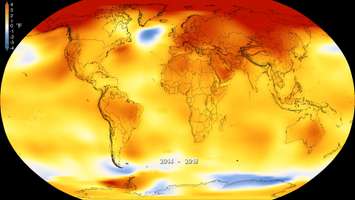
Scientists at NASA say the Earth is getting warmer and will continue to do so.
The National Aeronautics and Space Administration (NASA) is reporting that 2018 was the fourth warmest year on record since 1880. NASA said the Earth's global surface temperatures last year were the fourth warmest in almost 140 years, with the warming trends strongest in the Arctic region. Global temperatures in 2018 were 0.83 C warmer than the average temperature between 1951 to 1980, according to scientists at NASA’s Goddard Institute for Space Studies (GISS) in New York.
The independent analyses by NASA and The National Oceanic and Atmospheric Administration (NOAA) showed that globally, 2018's temperatures rank behind those of 2016, 2017 and 2015 and the past five years are, collectively, the warmest years on the modern day record.
“2018 is yet again an extremely warm year on top of a long-term global warming trend,” said GISS Director Gavin Schmidt.
Since the 1880s, the average global surface temperature has risen about 1 C driven in large part by increased emissions into the atmosphere of carbon dioxide and other greenhouse gases caused by human activities, according to Schmidt.
NOAA found the 2018 annual mean temperature for the 48 continental United States was the 14th warmest on record, the Arctic region saw the continuing loss of sea ice in 2018, and the mass loss from the Greenland and Antarctic ice sheets continued to contribute to rising sea levels.
NASA and NOAA added that increasing temperatures can also contribute to longer fire seasons and some extreme weather events.
“The impacts of long-term global warming are already being felt in coastal flooding, heat waves, intense precipitation and ecosystem change,” said Schmidt.
NASA’s temperature analyses came from 6,300 weather stations, ship and buoy-based observations of sea surface temperatures, and temperature measurements from Antarctic research stations.