
The Nature Conservancy of Canada (NCC) is asking motorists to give turtles a 'brake' while out on the roadways.
According to the NCC, turtle populations are declining in Canada due to being run over by vehicles.
Kristyn Ferguson, program director with the NCC, told Blackburn News that this an active time for turtles to be spotted outside of their normal habitat.
"This is a peak time of year where turtles are found on the road, crossing roads, looking for new nesting areas on the side of the roads. So people are going to be seeing a lot more turtles out and about," said Ferguson.
Ferguson and her colleagues are committed to making the roadways safer for the reptiles and making sure people know what to do if they come across a turtle on the road while driving. Ferguson stresses the importance of making sure human safety is a top priority and recommends only pulling over if it's safe to do so.
If you are able to pull over and get out, she said the first things to do is check what type of turtle you are dealing with and use a specific approach depending on whether it's a snapping turtle or any other type of turtle.
Ferguson said snapping turtles are distinguished by their prehistoric look and spikey tail. Snapping turtles will bite when scared by Ferguson said there is a tailor-made way to pick them up without risking getting snapped.
"If you reach onto the base of its shell, on either side of its tail, there's almost two handles on the back of the shell," she explained. "Then you sort of tip the turtle forward and this will force it to start walking on its front legs."
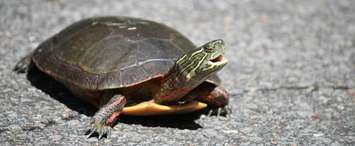
Unlike all other turtle species, a snapping turtle is not able to put its head into its shell. If you come across a kind of turtle that can go into its shell, such as a painted turtle, Ferguson said it's fairly easy to help them cross the road.
"You can pick these guys up, we say, like a hamburger, sort of holding top and bottom on both sides just lift it up and move it off the road," she said. "You always want to move a turtle in the direction it was going. Because, even if it's close to one side of the road, if it was pointing in the other direction, it is going to head across to that other wetland no matter what, they're very determined. So move it the way it was going to help it get on its way safely."
According to Ferguson, it can take up to 20 years for some turtles to get to the point where they can reproduce. Currently, she said, all turtle species in Ontario have been accessed as species at risk. She added that turtles are vital parts of the ecosystem and it's important for humans to do their part when they can to protect them.
"Turtles really act as wetland janitors, is what we call them," she said. "They're there cleaning up the dead plants and insects, they're just sort of ingesting all those particles in the wetlands and helping digest them and helping turn them back into nutrients that are available for other animals in that wetland system to use."
https://www.youtube.com/watch?v=F4aPiN-kGYA