
With Chatham-Kent council set to make a vital decision about tree clearing in the next few months, residents on both sides of the issue are working overtime to ensure their opinion is heard.
Earlier this spring, council approved a motion introducing a temporary bylaw that prohibited the removal of woodlots for 120 days.
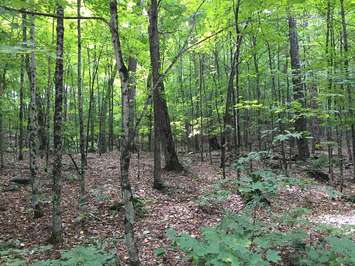
Councillor Aaron Hall was behind the idea, saying that Chatham-Kent currently has one of the lowest percentages of tree cover in all of Ontario and citing the municipality’s previously identified goal to develop approaches to protect natural resources. After it was introduced, Hall's woodlot preservation motion narrowly passed in an 11-7 vote.
The motion also directed municipal staff to launch an engagement process to seek the public’s input on options to manage woodlots in Chatham-Kent.
As a result, an online engagement survey to get resident feedback was available for several weeks earlier in the summer. The survey closed on July 9, 2021.
According to Chief Administrative Officer Don Shropshire, he recently received confirmation that 1,600 people filled out the survey, but added that he has not seen the full results yet.
"I haven't seen any of the data in terms of what people are recommending, one way or the other," Shropshire said, noting that 40 per cent of the people who filled out the survey identified themselves as property owners with woodlots.
Brian Wright, a farmer from the Bothwell area, is one of the individuals who identifies himself as a Chatham-Kent property owner with a woodlot.
He is also the spokesperson for the Chatham-Kent Land Owners Association, which was formed a little less than a month ago. According to Wright, the group is made up mainly of members from the agriculture community who are opposed to a tree clearing bylaw.
Wright said the Chatham-Kent Land Owners Association was formed as a way for individuals who are against the bylaw to help get their thoughts out to the public and spread their platform.
"We're also trying to educate as many people as we can," said Wright. "We're not here to slam anybody, we realize there's going to be resistance and this is just the way the process works. We will continue our battle and carry on."
Wright said the group is supported by the Kent Federation of Agriculture (KFA), which also recently expressed public opposition to implementing a permanent bylaw.
FKA President Jay Cunningham previously told Blackburn News that he believed the bylaw singles out farmland owners and creates an uneven playing field.
Wright said the Land Owners Association would appreciate being able to continue farming the same way that they have been for many years -- without the added restrictions.
"The main concern is, we buy our land, we pay for our land, we pay the taxes on our land. We should have the right just as anybody in town, to say what we do with our property," said Wright. "We don't ask anyone else to take a pay cut on their wages and if they're asking us to reforest certain parts of our land that we've bought and paid for, that's basically telling us to cut out some of our income."
A similar temporary bylaw was first presented to council in 2013 and eventually voted down. Later that year, council received but did not vote on, a draft bylaw to incorporate woodland conservation and preservation through regulation.
In 2014, Chatham-Kent council opted to adopt a Natural Heritage Implementation Strategy that focused on promoting conservation through education rather than a bylaw or penalties for clearing woodlots.
Wright echoed the sentiments of the KFA, saying he would like to keep that Natural Heritage Strategy in place rather than introduce a permanent bylaw.
"I think the biggest thing is if people would educate themselves on the Natural Heritage strategy that was imposed in 2014. It was working. Somehow it stalemated, I'm not sure where it stalled but it did somewhere along the line," Wright said. "I think if [the municipality] went back to that and if everyone would educate themselves on what was going on, I think we would have a pretty good resolve."
The KFA also previously said it would be willing to participate in updating the strategy as needed.
However, for those in favour of a woodlot bylaw, not having any concrete enforcement in place to prevent tree clearing simply isn't enough to protect tree coverage in Chatham-Kent.
Andrea O'Rourke is a founding member of the CK Woodlot Preservation group, which was formed several years ago when the issue first went to council.
O'Rourke said she believes that the Natural Heritage Strategy doesn't work and that regulation is needed. She believes individuals will take advantage of the fact that there is no bylaw in place and woodlots will continue to come down.
"I would love if that strategy worked. We tried it, we're still losing," she said. "It's a voluntary measure and voluntary measures don't seem to be working."
CK Woodlot Preservation group is also working to increase its support base ahead of a decision by council.
The group recently announced that it will move from more of a social media-based group to forming an official membership list. According to O'Rourke, the group is encouraging other individuals who are in favour of a bylaw to become a member.
She said one of the biggest misconceptions is that the CK Woodlot Preservation group is anti-farming or trying to hurt the agricultural industry. According to O'Rouke, several members of the group are farmers themselves.
"We wanted to make sure that those who are making this decision, which is council, know that we're not a small group, we're not a special interest group either. This is everybody's interest," she said. "We know [tree coverage in Chatham-Kent] is hovering around three per cent. That's all we have left. As far as restricting anyone's ownership, that's all we have left, we're talking about a very small amount of tree coverage that remains."
Hall's motion also requested that staff conduct an analysis of best practices for incentive programs and woodlot preservation across Ontario as well as create an incentive program, with the goal of preserving woodlots in the community and providing landowners with tangible and flexible options for being included in the program.
"If [the landowners] are concerned about regulation, then incentivize," said O'Rouke. "Kind of a balance of the two things, maybe a compromise. It's a really divisive issue and I think what we'd like to see is more people working together. We need to acknowledge the problem as a problem and not just say 'nope, you cant tell us what to do.' It's a problem that I think we can all agree. We have barely any [trees] left and we're just fighting about the scraps on the table."
Shropshire noted that the public survey is only one factor and data point that will help guide council's decision. Another piece will be an analysis by the Lower Thames Valley Conservation Authority on how much tree coverage Chatham-Kent has, which he said is routinely done every four years.
Shropshire said he expects that a more "wholesome consideration" of the issue will come back to council in the next few months.
"The time period for getting back to council, or the community as a whole, with the accurate tree count and analysis by the Lower Thames Valley Conservation Authority, I'm not expecting that to be available for several weeks and I haven't gotten a confirmed date one when we're expecting to go back," he explained. "I think there might be at least an update [at an August council meeting.] Then I expect sometime after that, we'll be back to council when the additional information's available."