
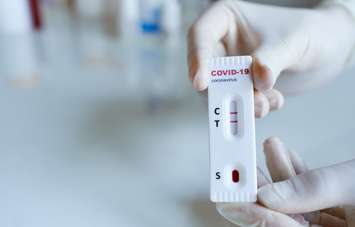
Ontario announced Tuesday morning that rapid antigen COVID-19 testing will be made available in schools and licensed childcare centres as early at next week.
But Chatham-Kent's Medical Officer of Health is not a fan.
"We've been running a pilot study on rapid testing in schools, and personally I don't think its utility has been proved," said Dr. David Colby. "Tests that are rapid tests are not as accurate as the PCR test, and we end up getting a lot of false positives and false negatives."
Students who test positive will be required to get a PCR test at an assessment centre and self-isolate until the results are known. Those who test negative can go to school.
Dr. Colby said the rapid tests are useful, but not for screening large groups of asymptomatic people.
"That kind of testing is only a snapshot. You could be negative this morning, and infectious by noon if you're exposed a few days ago. So those kinds of tests, you have to use a lot of them, and I don't think their utility in terms of preventing outbreaks, has really passed the muster test."
He adds that the rapid tests can lead to false positives and false negatives.
"False negatives are dangerous because they give you a false sense of security," said Dr. Colby. "False positives create a lot of work for nothing. You either prove they are false positive or go through all the isolation, and in the meantime, it takes a lot of effort."
So what is the best way to screen children before school? Dr. Colby said it's better to do a thorough and honest symptom screening.
"'Are you feeling okay?' 'Have you been exposed to anyone who has COVID?' 'Have you travelled recently?' And then not just 'Do you have any symptoms?' but 'Do you have a fever?' 'Do you have a sore throat?' like all of these kinds of tests that are associated with COVID infection."
The recently announced COVID-19 rapid tests will be used only on students who are unvaccinated, asymptomatic, and considered low-risk contacts. It will be voluntary, and parents will administer the test at home.