

A new report by Chatham-Kent Employment and Social Services is giving some insight into the work that's been done and what still needs to be accomplished when it comes to fighting homelessness in Chatham-Kent.
The annual report going to municipal council on Monday night highlights the progress that was made in 2021 on the targets and goals of the Chatham-Kent Housing and Homelessness Community Plan 2020-2024.
"Chatham-Kent’s original Housing and Homelessness Community Plan was adopted in 2013," read the report. "It was instrumental in the development of programs and shifting service delivery to reflect data-driven, outcome-based solutions and best practices to address housing and homelessness needs. In 2020, council approved a five-year housing and homelessness plan that set the foundation for continuous outcome-based improvement over the five years."
According to the report, Chatham-Kent's vacant rate has seen a sharp decline over the past few years. In 2021, it dipped to around -1 per cent.
A vacancy rate of three to five per cent is considered a healthy balance. This means that tenants can find suitable units to rent and property owners can find suitable tenants for units. A healthy vacancy rate also keeps rental rates in check.
"When vacancy rates are higher than four per cent, the rental market is supply strong/demand weak, meaning there are more rental units than required," the report stated. "When the vacancy rate is less than three per cent, the market is demand strong/ supply weak, meaning there are more households seeking rental properties than there are suitable units."
Since 1991, Chatham-Kent’s vacancy rates indicated a supply heavy market with little need to increase the number of rental units. However, Chatham-Kent switched to a demand heavy market in 2017 coinciding with the beginning of the southwestern Ontario real estate bubble.
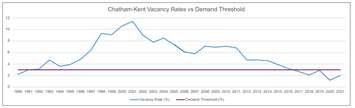
"When the municipality became demand heavy for rental units, market rents increased considerably and the need for purpose-built, affordable housing units became stronger than ever."
As vacancy rates decrease, rental rates continued to soar in 2021. According to the report, rental rates in Chatham-Kent have jumped by 67 per cent from 2015 to 2021.
In 2021, the average market rent of a one-bedroom unit was $1,050, an increase of 12 per cent from 2020 when the rate was $938.
Despite these challenges, progress continues to be made in the development of affordable housing with the addition of 77 units through new builds by private developers, nonprofit organizations, and Chatham-Kent. The combined municipally funded and federally funded portable housing benefits significantly increased in 2021 providing affordable housing for 214 households.
There are a total of 694 units for Chatham-Kent public housing.
Of the 718 applications currently on the rent-geared-to-income waitlist in Chatham-Kent, 28 per cent are families, 24 per cent are seniors and 28 per cent are single individuals.
According to the statistics in the report, 366 unique individuals experienced more than 14 days of homelessness in 2021. Of those individuals, 65 per cent were male, 34 per cent were female and one per cent were transgender. The average age of individuals experiencing homelessness was 38 and 12 per cent of the individuals were Indigenous.
The number of people homeless in the month of December in Chatham-Kent has more than doubled since 2018, according to the report. There were 198 individuals identified as being homeless in December 2021 compared to 96 in December of 2018.
The average length of stay in emergency housing through the Chatham-Kent Emergency and Rapid Rehousing Program is 48 nights. The program is a housing-focused emergency housing option that is focused on contributing to the municipality’s goal of ending chronic homelessness and making the experience of homelessness as brief as possible.
The report stated that a total of 18,105 total emergency shelter nights have been provided through the program and it's helped to move 128 people from emergency to long-term housing.
There was some other continued progress made in 2021 by the municipality to get people into permanent housing.
Through Chatham-Kent Community Assessment, Referral and Evaluation Services, a group that represents six community organizations that operate supportive housing programs in Chatham-Kent, 260 previously homeless households were assisted to move into long-term housing in 2021.
According to the report, The Homes 4 Youth program supported 64 youth in 2021, 11 new youth were housed in 2021, and 45 youths are currently receiving supportive housing services.
Twelve previously homeless adults were housed through the CMHA Intensive Case Management Program in 2021 and 22 previously homeless adults continue to receive supportive housing services through the program.
"Private landlords and private non-profit housing providers continue to be integral in the current supply of affordable housing," the report stated. "Increased housing stability was achieved in 2021 through engagement, integrated service with community agencies, and program supports reflective of the needs identified."