

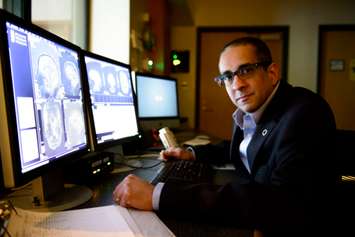
Researchers at Western University have found that young hockey players who have suffered concussions, still show changes in their brains months after being cleared to return to the ice.
A study was published in the October 25 online issue of "Neurology", and explained that the discovery was made through sophisticated Magnetic Resonance Imaging (MRI) techniques.
Researchers looked at MRI brain scans from 17 Bantam-level hockey players, between the ages of 11 and 14, who suffered a concussion during the regular season. Most of the concussions were a result of falls that resulted in a hit to the back of the head.
The players were tested within 24-72 hours of suffering the initial concussion, and again three months later. At this time, all the young athletes had been cleared to return to play after reporting no symptoms during clinical evaluations.
“What the MRI shows is that there are still changes occurring in the brain even after the clinical tests have returned to normal,” said Ravi Menon, PhD professor at Western’s Schulich School of Medicine & Dentistry and a scientist at Robarts Research Institute. “This is potentially of some concern and we’d like to understand this further to determine if these are normal healthy changes or if they are indicative of something that might be going wrong.”
On both the first scans and the scans taken three months after the concussions, researchers noticed that the very long fiber tracks in the brains of the players were damaged. "Hyper-connectivity" was also seen in some areas of the brain, which researchers say is the brain possibly trying to compensate for the injury.
“If we can come up with a clinically-relevant, objective measure for concussion diagnosis and recovery, we can make safer decisions about return to play,” said PhD Candidate Kathryn Manning at Western’s Centre for Functional and Metabolic Mapping at Robarts. “This study has the potential to help develop that.”
https://www.youtube.com/watch?v=5BD4OkcmcPI