
Shadia Keza survived the Rwandan genocide only to suffer years of physical and sexual abuse at the hands of her aunt and husband.
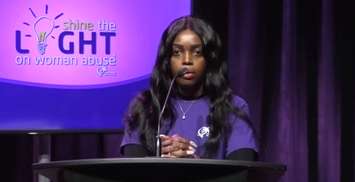
The recent Fanshawe College graduate and mother of two fought back tears as she shared her story on Friday at the virtual launch of the London Abused Women's Centre's (LAWC) annual Shine the Light on Woman Abuse Campaign.
Keza was just 7-years-old when her parents died during the Rwandan genocide. She was eventually sent to live with an aunt in Uganda.
"My aunt introduced me to the world of men's violence against girls and women. She was not a good person and she really only wanted me around so that I could make money for her. She ran a brothel and expected her own children and family to sell their sexual services," explained Keza.
At 14-years-old and not wanting to have sex with strange men, Keza refused to sell her body. As a result she was made to sleep outside and was denied food. She believes she would have died during this time had her cousin not secretly brought meals to her.
"There was always a man ready for me to have sex with, but I kept saying 'no' and I kept being punished for doing so," Keza said.
Because she was not turning a profit, her aunt sold her to a male family friend a year later. She had a child with this man, a child she ultimately had to make the tough decision to leave in the man's care so that the tot didn't have to sleep outside with her.
In Keza's final effort to get away from her aunt, who still controlled her every move, she married a man she met in her village three years later.
"I felt like I had no other options and nowhere else to go. Like my very life was depending on him. It turned out life with him was no different than life with my aunt," said Keza. "He did what he wanted to me because he knew I had nowhere to go. His abuse kept growing. I got beat almost every day. If I said something he didn't agree with he would slap me. It didn't matter if there were people around. I came to believe no one could help me."
One day when Keza ran into her cousin, her husband warned her he would cut off both of her hands if she dared wave to her relative - a bid to keep her isolated. He would demand she get up in the middle of the night and go into town to get him a drink. When she would return empty handed because the store was closed, he would beat her.
"I felt scared and helpless. I wasn't a wife anymore, I was a slave. He gave me a roof over my head and food in my stomach, but he also controlled whether I lived or died," said Keza. "Even though I was living, I felt dead... I had nowhere to go, no support, nobody I could talk to. I was in a sort of jail and it was terrifying."
The couple moved to Canada, where the abuse continued for some time before Keza built up the courage to leave. After a total of seven years of marriage, Keza thought she was free. However, she continued to be subjected to his abuse as the case moved through family and criminal courts.
To this day, she said she is still afraid of him and only feels safe when he is in prison.
Despite this struggle, Keza went on to become a Canadian citizen and graduated from the police foundations program at Fanshawe College. Her dream is to become an RCMP officer so she can help protect people in the community.
"I want women to know they are not alone. I want women to know that there are places to go to get help and that there are people there to support them. I want women to know that we are strong," said Keza.
She is one of two women being honoured through this year's Shine the Light campaign. The other woman, Rebecca Amendola, will share her story of survival during the campaign’s illumination of the Tree of Hope in Victoria Park on November 1.
Shine the Light, first launched in 2010, is an initiative created in London to cast a spotlight on the issue of men's violence against women. During its month-long run, buildings throughout the city and country are bathed in purple light. The colour purple is a symbol of courage, survival, and honour. Since its launch in 2010, the Shine the Light has gone from being a local awareness campaign, to a national and international one. Communities in Sweden and Australia adopted the campaign in 2017.
"This year's Shine the Light on woman abuse campaign, as every year in the past, will be unbelievably impactful for our entire community and beyond," said LAWC Executive Director Jennifer Dunn. "I want to encourage you to create conversations and raise awareness of what is happening in our world and in our community. Wear purple on November 15, talk about it to people you know. Talk about it to people you don't know. Create those conversations."
According to Dunn, the abused women's centre has helped more than 3,800 women and girls through individual and group support this year. The agency also handled roughly 5,400 calls for support over the past ten months.
"These numbers included a 45 per cent increase in our urgent services program," said Dunn. "The demand for service continues to increase and thankfully for the generosity of our community, the London Abused Women's Centre was able to hire three new advocate counsellors this year. This ensures we are able to provide women and girls with immediate access to support."
A list of Shine the Light events and important days being held throughout the month of November can be found by clicking here.