

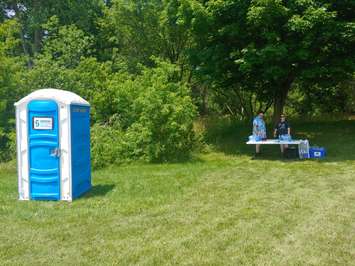
A short-term solution to assist London's most vulnerable population began Tuesday, offering basic care and support to those living in encampments.
Four service depots opened across the city on July 4, as part of London City Hall’s newest 90-day strategy to bring support to the local homeless population.
Each outdoor depot, located in Ann Street Park, Cavendish Park, Wellington Valley Park and Watson Street Park, will operate for 90 minute sessions per day, seven days a week throughout the summer and into the early fall. The depots will offer support including food and water, harm reduction and hygiene supplies, washroom access, fire safety and connections to social support programs.
Related: Craig Needles Podcast Episode 182: Examining London's homeless service depots
Chantelle McDonald of London Cares said the depots will serve as an interim solution for the next 90-days to help individuals in gaining support they urgently need. The depots will be set up and taken down daily, they are not indoor hubs offering 24/7 care, which McDonald acknowledged some community members were confused about.
“I can understand the community’s concern, this is new and we really want to work with the whole community,” said McDonald. “What we’re doing right now is we’ve picked the depot locations based on a mapping system from the City of London that tracks where encampments already are.”
London Cares has existing encampment protocols that it will utilize if problems from nearby encampments arise. Possible concerns the organization said it addresses include increased amounts of waste on site, too many individuals habitating an encampment, or use of weapons or violence.
During the 90-day period, the depots will assist homeless individuals in obtaining proper housing and/or services and solutions that will keep them alive while work is done on long-term solutions.The London Homeless Coalition has reported 28 deaths among the homeless community in 2023.
Kevin Dickins, the Deputy City Manager of Social and Health Development said the city hopes that as the depots operate over the next three months, the public will become more aware of the services offered, and hopefully more accepting. He explained that outreach workers are looking to build trust with those living in the encampments, to hopefully have them come to the depots to support their needs, rather than desperately seeking it elsewhere.
“That’s the idea,” said Dickins. “Let this be a gateway to other formal services [to] get people to come out of those encampments, and trust us that are here to help. [We are] really trying to help people feel like there’s hope.”
Last week, City Hall approved $100,000 for London Cares and the Canadian Mental Health Association (CMHA) to fund the depots. An additional $255,000 was approved from the social service reserve fund for waste cleanup.
Dickins said a report will go to city council later this month with details for the long-term, permanent hubs, supported by a $25-million anonymous donation announced at the beginning of the year.
Despite concerns and criticism brought up by residents over the plans to address homelessness and the problems associated with it, Dickins feels it is important that the city not rush to come up with a plan that may fail. He added that positive outcomes of a well thought out plan will hopefully lead to a decrease in conflict and survival crimes in city neighbourhoods.
“We are trying to meet people with dignity and respect, and I think you’re going to see that reciprocated by those receiving services,” said Dickins.
-With files from Craig Needles