

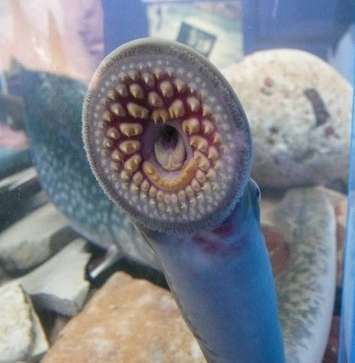
The Great lakes Fishery Commission says the numbers of invasive sea lampreys have reached a thirty year low in Lake Huron.
The sea lampreys invaded the lakes through shipping canals and had spread throughout the system by 1939---inflicting the worst ever human caused disaster on the great lakes.
The great lakes fisheries is worth 7 billion dollars, and without controls on the lamprey, the industry would suffer significant ecological and economic harm.
“This new information about sea lamprey abundances is outstanding news,” said Dr. Robert Hecky, the commission’s chairman. “Today, sea lampreys are at their lowest levels in Lakes Huron and Michigan since 1985 and 1995, respectively. Also, after being too high in Lake Ontario for about ten years, sea lampreys are now below target levels in that lake. We still have work to do in Lakes Superior and Erie, but sea lampreys there are on a steady downward trend. We will always work aggressively to reach our targets in all lakes.”
levels of the lamprey are at a twenty-year low in Lake Michigan, and to below the target level in Lake Ontario. The commission also reported that although sea lampreys are above the target levels in Lakes Erie and Superior, the trends in both lakes follow a steady five-year decline
They attach to Great Lakes fish with a tooth-filled, suction cup mouth and file a hole through the fish’s scales and skin with a razor-sharp tongue.
The average sea lamprey will kill up to 40 pounds (18 kg) of fish during its parasitic stage.
Sea lampreys prefer trout, salmon, whitefish, and sturgeon, but they also attack smaller fish like walleye and perch.
“Overall, the sea lamprey control program has been a tremendous success,” said Hecky. “Before control, sea lampreys killed an estimated 103 million pounds [47 million kilograms] of fish per year. Today, because of control, sea lampreys kill less than 10 million pounds [4.5 million kilograms] of fish per year. This control program provides fish a chance to survive long enough to spawn, be caught by humans, or live a natural life. It also allows agencies to restore stressed species and maintain thriving sport, commercial, and tribal fisheries.”
Hecky concluded: “Sea lamprey control is worth the effort and is the foundation of the fishery we enjoy today. Before control, sea lampreys caused major economic and ecological harm. Today, fish communities are on the rebound and the fishery is worth $7 billion annually to the people of Canada and the United States.”