

More than a hundred organizations are calling on the Canadian and American governments to list radionuclides as a chemical of concern in the Great Lakes Water Quality Agreement.
This as a new study points out the shortcomings in efforts to track the chemicals, and in properly monitoring the dangerous substances.
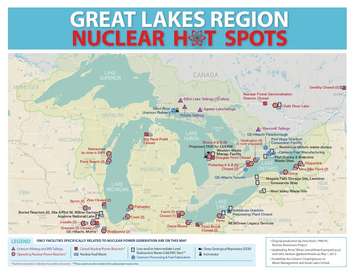
Author John Jackson says the Great Lakes basin has over 30 nuclear generating stations, fuel processing facilities, waste disposal, and uranium mine tailing sites around the four lower lakes.
The groups claim the cumulative impact of the facilities is unknown because there is no comprehensive monitoring that takes into account the total impact of all of those facilities.
In 1997, the Nuclear Task Force of the International Joint Commission highlighted the inconsistency of reporting and monitoring of radionuclides in the Great Lakes, but still nothing has been done.
1997 Report from Nuclear Task Force of the International Joint Commission
“What’s important to remember is that radioactive materials are constantly on the move around and across the Great Lakes. Whether it is fuel being shipped from a processing facility to power plants, waste being moved to storage sites, or tritium being shipped to a factory, these materials aren’t just sitting in one place,” says Jackson. "This opens up a real risk for accidental releases into the lakes themselves or into waterways that flow into the lakes.”
Jackson adds that the Great Lakes are actually more vulnerable than most water systems to substances building up over time because the water doesn't rapidly turnover.
He says building new nuclear waste storage sites near the Great Lakes is a big concern.
Jackson asked the Environmental Review Panel to consider the cumulative impact of a nuclear waste storage site in Kincardine along with the possibility of another nuclear fuel storage site in one of three nearby communities, which are among nine possible sites for that nuclear storage site in the Great Lakes basin. Jackson says that request was ignored, but he is pleased that the new federal environment minister feels the issue deserves study.
Jackson says communities that rely on Bruce Power to drive their economy, should diversify to cushion the impact of changes to a single industry.
“The evidence is that even very low levels of radiation can have serious health impacts, from cancer- causing cell damage to genetic mutations that can trigger birth defects,” says Kevin Kamps of Maryland-based Beyond Nuclear. "In the U.S., the Biological Effects of Ionizing Radiation panel found that there is no compelling evidence to indicate a dose threshold below which the risk of tumor induction is zero.”
“We simply don’t know what the cumulative impact of these nuclear facilities and waste sites is on the lakes because there is no comprehensive monitoring of radionuclides in Great Lake waters,” says Theresa McClenaghan, executive director of the Canadian Environmental Law Association.
“We need to get a better handle on the impact of radionuclides on drinking water quality, fish and wildlife survival and the health of aquatic ecosystems throughout the Great Lakes. Radionuclides are not included in the most comprehensive environmental monitoring programs for the lakes because our governments have not listed them as a chemical of concern. That needs to change so that we start keeping better track of what all of this nuclear activity around the basin means for the health of our lakes and ourselves,” says McClenaghan.
33-million people live within the Great Lakes basin, including 9-million Canadians, most who also use the lakes as drinking water.