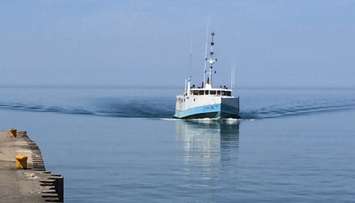
A commission has released a report identifying why there are reduced fish populations in four of the five Great Lakes, including Huron.
Allison Voglesong Zejnati, a communication specialist with the International Joint Commission, said the issue is called a near-shore shunt.
"The combination of invasive species and algae blooms in the near-shore are trapping nutrients too close to the shore. Not enough nutrients are feeding the food web out in the deep part of the lake," said Zejnati. "The International Joint Commission Science Advisory Board recommends that the scientists and managers who are working both on fisheries and on water quality, addressing nutrients, they need to do better to work at an ecosystem-based scale."
She added the issue isn't just affecting fish populations but size as well.
That's creating serious problems for both sports and commercial fishing in Lakes Huron, Superior, Michigan and Ontario.