
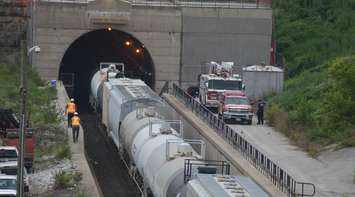
The Transportation Safety Board (TSB) has determined that structural defects in some rail cars likely contributed to a derailment in the St. Clair River Tunnel over a year ago.
 Rob Johnston (photo courtesy of TSB)
Rob Johnston, Manager, Head Office and Central Regional Operations with the Railway Pipeline Investigations Branch, believes the 53rd car, which was loaded with scrap steel, was the first to leave the tracks on the Canadian side of the tunnel June 28, 2019.
"We've completed some compression testing on three of the subject cars that were involved, they were bathtub gondola cars that were used in scrap steel service, and we found that there was some structural defects that we felt the industry should be aware of," said Johnston. "So, we recently issued a safety advisory to that effect, asking the industry and the regulators to locate and examine all of these cars to ensure they're safe to travel."
 St. Clair River Tunnel Derailment June 2019 (Photo courtesy of TSB)
Johnston said the A-end of the 53rd car, showed extensive damage, had a broken knuckle and appeared to have collapsed, but he said they're still determining if that's the official cause.
"There's certainly a number of factors that go into that and we're still working to pull the full report together for that, but these are factors that would be involved in the derailment in some way, shape or form."
TSB has advised Transport Canada and the US Federal Railroad Administration to ensure all bathtub gondola cars, built by Berwick Forge and operated in North America, are identified, located and examined.
The tunnel linking Sarnia and Port Huron, Michigan was closed for 11 days after the derailment.
CN employees and contractors worked around the clock and over holiday weekends in Canada and the U.S. to clear the track.
Of the train's 140 cars, 125 were loaded, 12 were empty and three were residue cars.
There were no injures in the derailment.