If there ever is a rail disaster in Windsor-Essex, first responders now have a pretty good idea how they should respond to it.
Paramedics, firefighters and police officers are taking part in four sessions designed to open a line of communication between first responders, the Essex Terminal Railway, and the Railway Association of Canada.
Among the lessons learned, they're finding out who to contact first in the event of a rail disaster.
"It's better to get to know each other at something like this than at 3 o'clock on a Sunday morning when you meet for an incident," says Ivan Pratt, a supervisor at the Essex Terminal Railway Company.
 The inside of a tanker car during training exercises in Windsor, March 28, 2018. (Photo by Adelle Loiselle)
Pratt says the railway puts together a safety plan that is reviewed annually with the communities they travel through; Windsor, LaSalle, and Amherstburg. They also provide lists each year of what dangerous goods trains are transporting.
In Windsor-Essex, those goods are mainly electrified petroleum which is transported to Plains Midstream on Matchette Rd. in Windsor, and alcohol, taken to the Hiram Walker facility and Diageo in Amherstburg.
Andy Ash with the Railway Association of Canada says he has been holding sessions like this for 25 years across Canada. Just previous to the disaster in Lac Megantic in 2013 had held one in Sherbrooke, Quebec. He admits those in the rail safety industry took the tragedy personally and says it validates the association's message.
"We can't afford to put on the blinders. We have to look at the big picture when it comes to our first responders when you're talking about this type of movement of dangerous goods," he says.
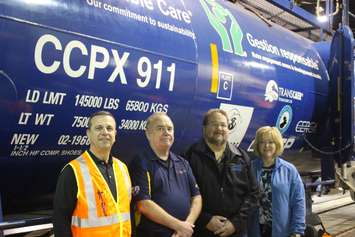
 First responders attend emergency training March 28, 2018. (Photo by Adelle Loiselle)
Although the session is voluntary, Pratt says attendance is always good.
As for the communities, like Windsor, that have dangerous goods being transported through them, Pratt's message is simple.
"We move dangerous goods safely," he emphasizes. "Before we even pick them up from an interchange or customer siding, they are inspected by qualified car inspectors. Fortunately, in our situation, we move at 10 mph an hour throughout Windsor and Essex County. At 10 mph, it's very limited what could happen."