

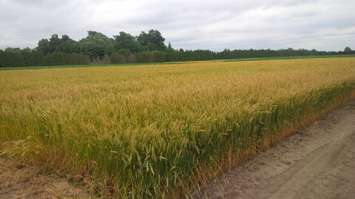
Agronomist Peter Johnson says he was very excited about this year's wheat crop earlier this spring.
Johnson was expecting a record crops and lodging wasn't looking like it was going to be a problem.
Then two things happened.
The first was that stripe rust came in early.
He says some people caught it in time and were able to control it but those who didn't will really pay the consequences.
The second was the lack of rain.
Johnson points out if farmers only get 21 days out of a possible 35 days of grain fill the sandy or eroded fields will take somewhere between a twenty to thirty per cent yield hit.
He adds throughout the province overall he believes the lack of rain will mean a reduction in yield of about ten per cent.
While that's not a disaster, Johnson suggests it's still a hit considering what the crop had looked like in the spring.
Johnson adds any rain now won't have much impact.
He says most of the wheat crop has started to mature and the window has been closed.
===
Johnson says a couple of things have happened to change his original expectation for this year's winter wheat crop.
[audio mp3="http://blackburnnews.com/wp-content/uploads/2016/07/JOHNSON-Wheat-1.mp3"][/audio]
===
Johnson says the lack of rainfall saw the wheat in very sandy fields or on eroded clay knolls burn prematurely.
[audio mp3="http://blackburnnews.com/wp-content/uploads/2016/07/JOHNSON-Wheat-2.mp3"][/audio]