

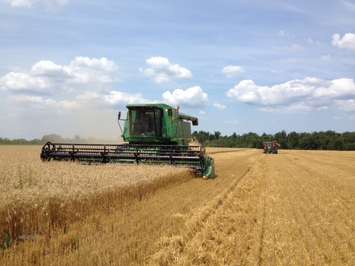
OMAFRA's Field Crop Team reports winter wheat harvest is 10 to 14 days ahead of last year.
The quality of the crop has been good and yields have exceeded expectations - given the lack of rainfall.
Ministry specialists point out a significant amount of annual weed seeds can be produced and dispersed after wheat harvest if the ground is left fallow.
They're suggesting growers plant a cover crop or use shallow tillage to cut down on that problem.
Western bean cutworm moths have been found in traps throughout Southwestern Ontario - a potential problem for both corn and edible beans.
OMAFRA says moths have been laying egg masses which have now become visible in some fields.
For corn - the action threshold is 1 egg mass per 20 plants.
It's suggested growers download the Pest Manager app - www.pestmanager.ca - for access to management options for western bean cutworm.
And while there have been no significant reports of soybean aphids, the ministry says regular scouting should be done from now until the R6 stage to minimize any yield lost from this pest.
The action threshold for the soybean aphids is 250 per plant and with actively increasing populations on 80 per cent of those plants.
===
OMAFRA Field Crop Report
By: The OMAFRA Field Crop Team Cereals Winter wheat harvest is in full swing throughout much of the province with some farms already finished, putting harvest 10-14 days ahead of 2015. Quality of the crop has been good and yields in general have exceeded expectations given the lack of rainfall. Straw yields have also been very strong.
Post-harvest weed management A significant amount of annual weed seeds can be produced and dispersed after wheat harvest if the ground is left fallow. In some years, annual weed seeds can mature in as little as 4 weeks after harvest. Planting a cover crop (i.e. oats) after wheat harvest can do a nice job at minimizing the amount of annual weeds going to seed and then allows an opportunity in the fall to terminate the cover crop and deal with perennial weeds at the same time. If it is not desirable to plant a cover crop, shallow tillage can also reduce the amount of weeds setting seed and will allow the perennial weeds to re-grow so that they can be managed in the fall.
If red clover was inter-seeded into the wheat crop there are a couple of ways that you can knock back annual weed growth so that you can let the clover grow as much as possible and maximize its nitrogen credit. The tried and true method, but most labour intensive, is to “clip” or trim the top of the red clover which will ‘chop off’ the weed seed heads at the same time. More recently OMAFRA and the University of Guelph have experimented with the application of MCPA as a way to manage broadleaf weeds in a red clover cover crop. There are three key learnings from this work.
1) The ester formulation of MCPA (Figure 1) causes significantly less plant damage than the amine formulation (Figure 2) 2) Red clover biomass is initially stunted during the first week after application but does recover within 2-3 weeks. 3) Targeting broadleaf weeds when they are smaller will result in better control; if annual grassy weeds are predominant, then the application of MCPA Ester will be insufficient and clipping is a better option to minimize weed seed dispersal.
Figure 1: Red clover at 7 days after an application of MCPA Ester (left) compared to an un-treated strip. Note the curling of the leaves giving a slightly grey appearance. Will be available as soon as possible on the Field Crop News website at: http://fieldcropnews.com/
Figure 2: Red clover at 7 days after an application of MCPA Amine (left) compared to an un-treated strip. The amine formulation has consistently provided greater foliar burn then the ester formulation. Will be available as soon as possible on the Field Crop News website at: http://fieldcropnews.com/
Corn Western bean cutworm moths have been found in traps throughout southwestern Ontario (Figure 3). An interactive map of trapping numbers can be found at http://goo.gl/yDz9wn. Moths have been laying egg masses which have now become visible in a few fields (Figure 4) with some approaching or are above the action threshold of 1 egg mass per 20 corn plants. Download the pestmanager app (www.pestmanager.ca) to have access to management options for this pest.
Figure 3: Map of Western Bean Cutworm found in traps throughout Ontario. Blue dots indicate no moths have been captured, green dots indicate 1-50 moths have been captured and yellow indicates 51-100 moths have been captured. Will be available as soon as possible on the Field Crop News website at:http://fieldcropnews.com/
Figure 4: Newly hatched Western Bean Cutworms (1st instars) from an egg mass. Will be available as soon as possible on the Field Crop News website at: http://fieldcropnews.com/
Soybeans There have been no significant reports of soybean aphids, although regular scouting should be done from now until the R6 (full seed) stage of soybean to minimize any yield loss with this pest. The action threshold is 250 aphids per plant, and with actively increasing populations on 80% of those plants.
Edible beans: Fields should be scouted shortly for western bean cutworm, refer to the moth trapping mapshttp://goo.gl/yDz9wn to identify areas where moths are actively being trapped.