

Changes to Canada's Environmental Protection Act could mean researchers will use fewer, or stop using altogether, animals for chemical toxicity testing.
The executive director of a centre at the University of Windsor dedicated to finding alternatives calls the amendments a landmark that puts "Canada on the cusp of transformation, ready to leap into a new era of research and innovation."
The Canadian Centre for Alternatives to Animal Methods opened four years ago and has been working to find viable alternatives to animal testing.
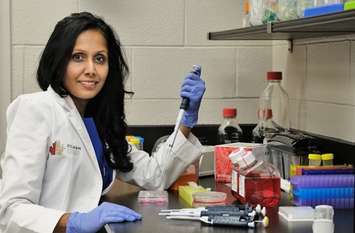
Doctor Charu Chandrasekera said it's time to embrace those alternatives.
"Our current reliance on animal toxicity testing is based on techniques developed decades ago," she said. "Fortunately, the world is witnessing a global shift, embracing a versatile toolbox full of 21st-century technologies like organ-on-a-chip, 3D-bioprinted tissue, and computational models to emulate human biology in a petri dish."
Chandrasekera was one of 71 witnesses who testified before the House of Commons Environmental and Sustainable Development Committee. She contributed language adopted in the final legislation, which received Royal Assent on Tuesday evening.
 © Can Stock Photo / ibreakstock
The amendments encourage the continued development of new technologies to replace, reduce, or refine the use of vertebrate animals in chemical testing. They also restrict the generation of data or investigation using rabbits, mice, guinea pigs, and birds unless it is not reasonably possible any other way.
The Vice-President of Research and Innovation at the University of Windsor is excited to see what it will mean for research.
"The amendments to Bill S-5 will position the Canadian Centre for Alternatives to Animal Methods at the forefront of Canada's transformation towards modernized toxicity testing," said Doctor Chris Houser.
Now that the legislation is law, the federal Ministers of the Environment and Health have two years to publish a plan to promote animal-free toxicity testing methods. The bill requires them to report annually on the nation's progress.
Animal rights group Animal Justice calls the bill's passage "a truly momentous day for animals in Canada."
Director of Legal Advocacy for Animal Justice, Kaitlyn Mitchell, said Canada can "finally catch up to jurisdictions like the U.S. and European Union, which already have strong legal tools to phase out these horrific experiments."
"Toxicity testing is the most harmful and painful use of animals in scientific research and involves experiments that often fall under the most severe category of harm that animals can experience," she said.
Researchers have used animals to find out if a chemical causes harm to the environment or adverse reactions like tumours, skin burns, blindness, birth defects, or death.
Animal Justice said more than 90,000 animals were used in testing in Canada in 2019.
The amendments also recognize the right to a healthy environment. A preamble emphasizes the importance of minimizing risks posed by toxic substances and considering vulnerable populations in risk assessments.