
"The reality is our practice of street checks will continue."
That, from London Police Service's Chief John Pare following public concern that people of colour are being unfairly targeted by London police officers.
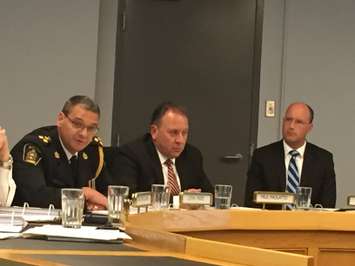
The issue was discussed at length during Thursday's London Police Services Board meeting and police agreed to further develop policies surrounding street checks.
Officials say while London police do partake in street checks, the process of "carding" is illegal.
Street checks are defined as and "investigative and crime prevention tool" and officials say they are done in the name of public safety. Often times, a person, vehicle or location that could be of interest to police is targeted.
Carding is defined as random act of asking a person on the street for their identification without cause.
In 2014, London police conducted street checks on 360,715 people; 71.3% of whom were white, 7.7% were black and 5.3% were of aboriginal descent. The majority of those checked were a known offender.
Police say street checks in 2014 led to the arrest of a peeping tom, the take down of a high risk domestic offender and the arrest of a sexual assault suspect. However, there is no paper trail of the checks leading directly to arrests or a break in on-going investigations.
"One of the criticisms that came from the community is that they're not effective, they don't lead to investigations, they're not a crime prevention initiative and they're not a part of a community immobilization. It's a fault in the system that we can't draw, by simply flipping a switch or checking the data to determine that it solved 25 assaults or resolved 35 robberies. I can't produce that information, so we need to look at a process that will a street check to those specific occurrences so we can demonstrate the value," says Chief Pare.
Board officials say while street checks are a valuable tool in policing there are gaps in the system at a local level, besides better data keeping, the London Police Service is promising standards for use, an auditing system, supervisory oversight, quality documentation and additional training at headquarters and the police college level.
In June, the Ministry of Community Safety and Correctional Services promised to standardize police street checks, stating "Ontario is moving to standardize police street checks across the province, and will establish rules to ensure these encounters are without bias, consistent, and carried out in a manner that promotes public confidence."
However, guidelines from the province have yet to be presented, following consultations with police forces and members of the public from across Ontario.
The issue was brought up at London City Council, where Mayor Matt Brown would not vote in favour of asking police to cease with street checks until the ministry guidelines were presented.
"Any practice that demonstrates and bias that doesn't protect everyone's rights is inappropriate," notes London Mayor Matt Brown. "Steps are now being taken to introduce a procedure specifically for this... The only time that a public street check is justified is that if it's for public safety or investigation purposes, any other process would be simply wrong and I think that's very important for our public to understand."
Both the chief of police and Mayor Brown encourage anyone who feels as if their rights have been violated to file a formal complaint.
The new policies and procedures surrounding street checks are to be presented to the London Police Services Board at the November meeting, as officials await the report from the ministry. What exactly the new policies will entail remains to be seen.
The lengthy street check report was requested in February by former London Police Chief Brad Duncan, long before it became a hot-button issue, officials say.