

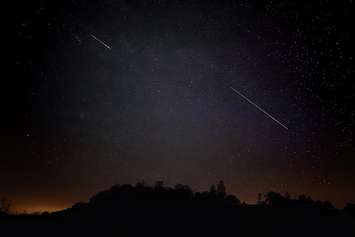
The Perseid meteor shower is set to peak this weekend, so Western University has launched a new website which can help determine how good the show will be on any given night.
The best time to view the Perseid meteor shower will be Saturday night into the early hours of Sunday.
"The prime time will be just before sunrise on August 12th or 13th. If you’re observing in the evening, start after 10 p.m. and look towards the east or northeast. Finding the Big Dipper can be a guide to spotting some Perseids," Denis Vida, project lead of the Global Meteor Network and postdoctoral associate at Western Science said.
"The waning crescent Moon won’t rise in the northeast until after 3 a.m. on [Sunday] and will be only a minor source of sky brightness. This means there will be very little interference with observations," he said.
Vida added that, if the sky is clear, those outside the city should be able to just look up and see meteors streak across the sky every few minutes.
Meteors will still be visible for several days after the peak prompting Western to launch its new meteor activity website.
The website features an easy to read gauge which predicts the likelihood of seeing meteors in a 24 hour span.
It uses the Zenithal Hourly Rate (ZHR) as a measurement. "The ZHR is not the number of meteors an observer will see in reality - for example, during the peak of the Perseids when their ZHR is about 100, you can expect to see about one Perseid every minute," the website explains. The ZHR is also calculated using ideal conditions, so the activity a person actually sees could be lower than the predicted value.
The Perseids, observed from Earth as shooting stars, are millimetre-sized dust particles, which enter the atmosphere at a hypersonic speed of 60 kilometres per second. "It only takes a brief moment after the meteoroid collides with the air molecules before the atoms emit light, which is when you can see a glowing trail in the sky," Vida described.
The meteors are called the Perseids because they originate from a point in the constellation of Perseus.
Star-gazers should be able to see about one meteor about every two minutes on Saturday.